
Length of stay cut for older patients moving through JGH Emergency Department
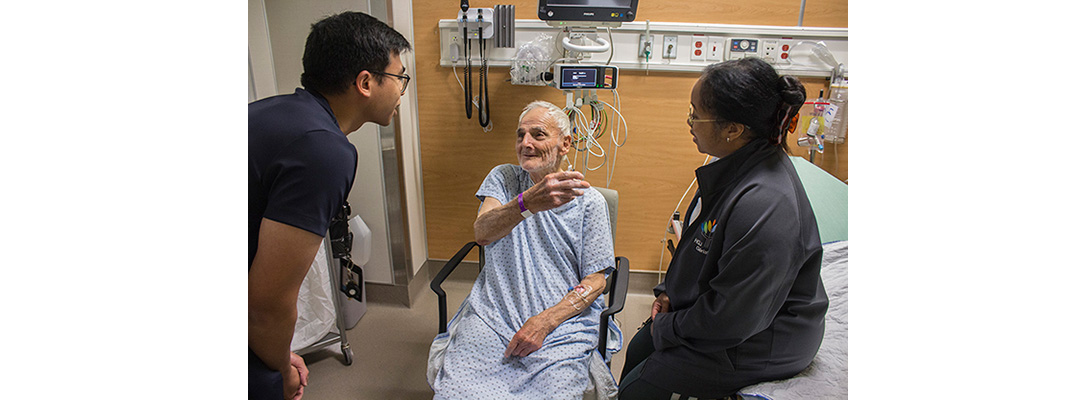
New approach aims to keep frailty from intensifying due to lengthy stays in the ED
Time spent by older patients in a bed in the Emergency Department (ED) has been significantly reduced, thanks to a new approach to the way these individuals are assessed and seen by clinicians.
Also streamlined at the Jewish General Hospital University Health Centre is the process of determining whether older adults in the ED should be admitted to the hospital or sent home.
The focus is on frail or vulnerable patients who are at least 75 years old and are at greater risk of falling, losing autonomy and mobility, or experiencing delirium.
The revamped approach, which relies on the ED’s newly created Geriatric Inter-disciplinary Team, was launched so recently that data about the results of its operations is only preliminary.
Nevertheless, Dr. Joel Turner, Chief of the Emergency Department, and Dr. Elise Levinoff, Chief of the Division of Geriatric Medicine, are encouraged by the initial numbers.
Since the new approach was introduced in March:
- Older at-risk patients have been spending an average of 21 hours in a bed in the ED, before being admitted to the hospital or discharged home—down sharply from 38 hours in 2025.
- About 54 per cent of these patients are being treated and discharged home directly from the ED, compared to just 17 per cent in 2025.
These figures are significant, because the proportion of older adults throughout society is continuing to rise. These individuals often have multiple medical problems that require more complex and more costly treatment.
The JGH is noteworthy for having the busiest Emergency Department in Quebec, with roughly 94,000 visits per year. Of these visits in 2025-2026, about 18,376 (19.5 per cent) were by patients at least 75 years old, and 7,715 (8.2 per cent) involved patients at least 85 years old—the highest such totals in the province.
Research has shown that medical problems are likely to become more serious, the longer an older, at-risk patient remains in the ED, says Dr. Turner.
According to Dr. Levinoff, the goal is to minimize any delay in sending an older patient home (with appropriate follow-up and support) or admitting that person to a bed, where the negative effects of hospitalization can be eased.
Patients screened at triage
In the new approach, patients aged 75 and over are screened at triage by being asked seven short questions (using a tool known as PRISMA-7), with answers provided by the patient or a family member.
The resulting score can flag a patient as having a higher likelihood of frailty, prompting a more extensive geriatric assessment.
In general, Dr. Levinoff says, older adults who are deemed not to be at risk are treated like any other ED patient.
However, she explains, if the patient is assessed as being at risk, various forms of support are available. For instance, a physiotherapist might help the patient out of bed (if appropriate) and keep them moving.
Also, medication might be adjusted, the patient might be placed in a special type of bed, or a nutritionist might be consulted.
In addition, a summary of the at-risk patient’s case is presented to the Geriatric Inter-disciplinary Team, which meets on weekdays in the morning and early afternoon.
Dr. Turner and Dr. Levinoff often attend the team’s meetings, along with a Geriatric nurse, geriatrician, discharge planning nurse, physiotherapist, occupational therapist and social worker. In the future, other professionals, such as a pharmacist, may be added to the team.
Collectively, these professionals determine who among them would be the most appropriate to see the patient, and what steps should come next.
Two key benefits
The advantages are two-fold, Dr. Turner says. First, the new approach eliminates the time-consuming practice of having the patient seen by several professionals, one after another. Instead, the team meets promptly and decides as a group how best to handle the patient’s care.
Second, unnecessary duplication is avoided. In the past, an emergency physician might have referred a patient to a discharge planning nurse, an occupational therapist and a physiotherapist all at once, even though only one or two of them were actually needed.
The new alternative is for the Geriatric Inter-disciplinary Team to decide exactly which of its members would be the most appropriate to see the patient.
This places the Team’s activities in close alignment with Care Everywhere, the broad, user-centred philosophy of care that has been embraced by the JGH and the other facilities in the Santé Québec West-Central Montreal Health and Social Services University Network.
The objective of Care Everywhere is for the right outcomes to be achieved by having the right professionals—in this case, members of the Geriatric Inter-disciplinary Team—provide the right care at the right time in the location that is the safest, most appropriate and most convenient for healthcare users.
Complementing these efforts, Dr. Levinoff says, is a push to have geriatricians and Geriatric nurses help the ED’s doctors, nurses and other professionals to more easily recognize the signs of delirium and to understand the negative consequences of even short-term immobility in a hospital bed.
Once the benefits of the new approach have been confirmed, Dr. Turner and Dr. Levinoff hope to expand the hours of the Geriatric Inter-disciplinary Team, so that its members see patients into the early evening and on weekends.
Dr. Turner says this focus on older adults is becoming more common in emergency departments across the country, with the Canadian Association of Emergency Physicians recommending a multi-disciplinary approach to treating frail elderly patients.
“Over all,” he says, “I think this will be a tremendous benefit to our older patients, at the same time as it improves the general flow of patients through the Emergency Department.”

Members of the Emergency Department’s Geriatric Inter-disciplinary Team (from left): Physiotherapy student Chelsea Gemma; Social Worker Zarema Bulgak; Occupational Therapist Tali Bouzaglo; Dr. Wayne Lok, Geriatrician; Social Worker Lauren Baer-Tenenbaum; Dr. Elise Levinoff, Chief of the Division of Geriatric Medicine; Discharge Planning Nurse Georgia Papadopoulos; Melissa Cacciotti, Discharge Planning Nurse; Physiotherapist Sabrina Commodari; Geriatric Nurse Felecia Armstrong; and Dr. Joel Turner, Chief of the Department of Emergency Medicine. (Click on photo to enlarge it.)
Related Posts


